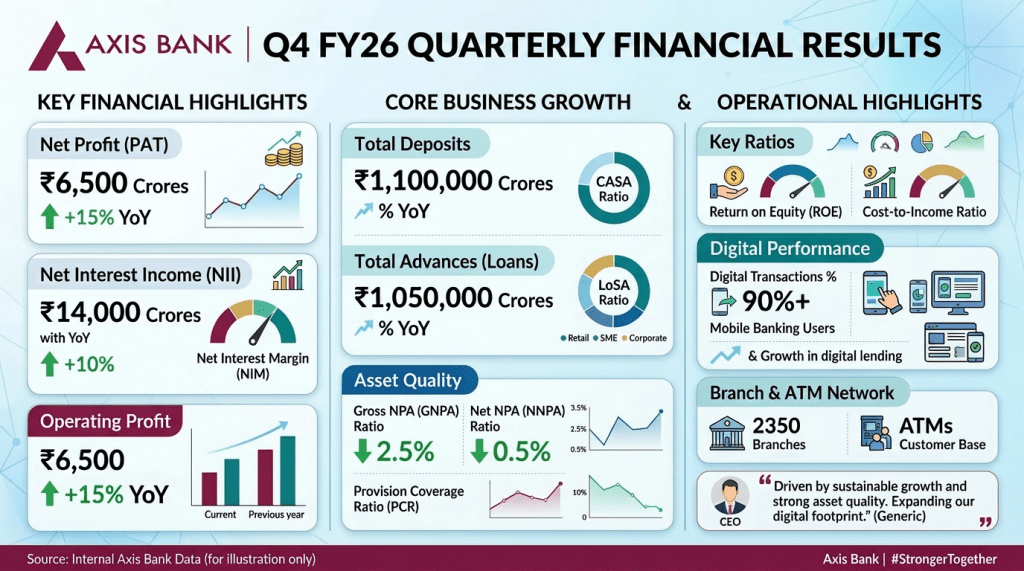
Quick Summary: AxisBank Results
- Q4 FY26 PAT at ₹7,071 cr (flat YoY ↓0.6%, up QoQ ↑9%) aided by a tax write-back
- Full-year FY26 PAT at ₹24,457 cr (↓7% YoY) as provisions jumped +71%
- Advances ₹12.34 lakh cr (↑18.5% YoY); Deposits ₹13.36 lakh cr (↑13.9% YoY)
- Asset quality steady: GNPA ratio at 1.23% (YoY ↑improved), NNPA at 0.37%; dividend of ₹1/share
AxisBank Financial Highlights
| Metric | Q4 FY26 | Q4 FY25 | YoY | FY26 | FY25 | YoY |
|---|---|---|---|---|---|---|
| Total Income | ₹38,747 cr | ₹38,022 cr | ↑1.9% | ₹1,53,163 cr | ₹1,47,934 cr | ↑3.5% |
| Net Interest Income (NII) | ₹14,457 cr | ₹13,811 cr | ↑4.7% | ₹56,048 cr | ₹54,348 cr | ↑3.1% |
| Other Income | ₹6,023 cr | ₹6,780 cr | ↓11.2% | ₹26,131 cr | ₹25,257 cr | ↑3.5% |
| Operating Profit (PPOP) | ₹10,013 cr | ₹10,752 cr | ↓6.9% | ₹42,817 cr | ₹42,105 cr | ↑1.7% |
| Provisions | ₹3,522 cr | ₹1,359 cr | ↓(higher) | ₹13,263 cr | ₹7,758 cr | ↓(higher) |
| Profit After Tax | ₹7,071 cr | ₹7,118 cr | ↓0.6% | ₹24,457 cr | ₹26,373 cr | ↓7.3% |
| GNPA / NNPA | 1.23% / 0.37% | 1.28% / 0.33% | ↑(GNPA better) | 1.23% / 0.37% | 1.28% / 0.33% | – |
| RoA (annualized, Qtr) | 1.58% | 1.83% | ↓25 bps | 1.45% | 1.74% | ↓29 bps |
| Capital Adequacy (CAR) | 16.42% | 17.07% | ↓65 bps | 16.42% | 17.07% | ↓65 bps |
| Advances / Deposits (Year-end) | ₹12.34 lakh cr | ₹10.41 lakh cr | ↑18.5% | ₹12.34 lakh cr | ₹10.41 lakh cr | ↑18.5% |
| Dividend (FY26) | ₹1 per share (50% of face value), subject to AGM approval | |||||
Why Key Numbers Changed (Important Insight)
- Profit vs revenue: Revenue grew modestly, but FY26 profit fell because provisions surged and operating costs rose faster than income. In Q4, profit looked resilient mainly due to a tax credit, not stronger operations.
- Margins: Loans grew +18.5% YoY, but NII rose only +3.1% YoY in FY26. This gap suggests margin pressure as funding costs rose and competition kept lending yields tight. Cost-to-income rose to ~48% for FY26 (Q4 ~51%), signaling higher operating intensity.
- Other income swing: Q4 other income fell ↓11% YoY, likely reflecting softer treasury gains and normalized fees, which pulled down operating profit.
- Provisions: FY26 provisions jumped +71% YoY and Q4 provisions were elevated. Despite a better GNPA ratio, the bank appears to have taken a more conservative stance (growth-related standard asset buffers and ageing of a few accounts), which depresses near-term earnings but strengthens coverage.
- One-time items: Q4 showed a tax write-back of ₹580 cr (negative tax expense), likely due to deferred tax adjustments and year-end true-ups. This is not a recurring driver of profitability.
Operational Performance & Business Trends
- Growth engine: Year-end advances rose to ₹12.34 lakh cr with double-digit deposit growth at ₹13.36 lakh cr. The loan-to-deposit ratio climbed to ~92% (from ~89%), indicating strong credit demand and tighter funding balance.
- Funding and costs: Interest expense grew in line with the rising rate/competition backdrop, while employee costs and other opex increased (investments in distribution and technology). This combination compressed operating leverage in Q4.
- Asset quality: GNPA ratio improved to 1.23% (QoQ and YoY), and NNPA at 0.37% remained low. Covid resolution framework exposure is small (~₹958 cr standard accounts outstanding), limiting tail risk from that book.
- Portfolio actions: The bank acquired retail and corporate loans and transferred some corporate loans during FY26, largely from higher-rated pools. These moves fine-tune risk-return without materially altering overall credit risk.
- Capital and buffers: CAR at 16.42% remains comfortable despite growth and higher provisions. A token dividend of ₹1/share indicates emphasis on capital retention to fund growth.
Management Commentary (Simplified)
- We are leaning into loan growth while keeping asset quality strong; provisions reflect prudence as the book scales.
- We continue to invest in people and technology, which lifts near-term costs but supports growth and service quality.
- We are optimizing the portfolio via selective acquisitions/transfers, focusing on better-rated exposures.
- Dividend is modest to preserve capital amid strong growth opportunities.
Key Positives
- Strong loan growth (+18.5% YoY) with stable headline asset quality (GNPA 1.23%).
- Healthy capital (CAR 16.42%) and rising net worth (₹1.96 lakh cr) support future expansion.
- NII growth remained positive despite pressure on margins.
- Resolution framework book is small; systemic Covid-related risks appear contained.
Key Concerns
- Provisions spiked (FY +71%; Q4 elevated), weighing on earnings and RoA.
- Margin and cost pressure: cost-to-income up; NII growth trails loan growth, implying NIM compression.
- RoA moderated to 1.45% (from 1.74%); needs improvement for re-rating.
- Funding tightness: Loan-to-deposit at ~92%; rising reliance on borrowings could keep cost of funds firm.
- Other income volatility (Q4 down YoY) adds unpredictability to quarterly P&L.
Final Takeaway for Investors
Axis Bank delivered solid balance-sheet growth and kept headline asset quality in check, but earnings quality was mixed. Higher provisions and operating costs outweighed modest revenue gains, and Q4 profit benefited from a tax credit that is unlikely to repeat. Near-term stock performance will hinge on stabilizing margins, normalizing credit costs, and better operating leverage. If the bank converts its strong growth pipeline into profitable growth while keeping asset quality tight, FY27 can look better. Keep an eye on deposit mobilization, cost control, and the provisioning trajectory.
FAQs
- What is revenue for a bank?
Revenue is the total income, mainly interest earned on loans and investments plus other income (fees, forex, treasury gains). Axis Bank’s FY26 total income was ₹1,53,163 cr. - What is profit?
Profit is what remains after all expenses: interest costs, operating expenses, provisions, and taxes. Axis Bank’s FY26 PAT was ₹24,457 cr. - Why did profit change this year?
Mainly due to higher provisions and rising costs despite revenue growth. In Q4, a tax write-back supported profit even as operating profit softened. - What are NPAs and why do they matter?
NPAs are loans where borrowers are not paying on time. Lower GNPA/NNPA means better asset quality and usually lower future credit costs. Axis Bank’s GNPA ratio improved to 1.23%. - Is Axis Bank a good stock to buy now?
It depends on your risk and time horizon. Positives are strong growth, solid capital, and stable asset quality. Watch for margin recovery, cost discipline, and provision trends before taking a call. This is not investment advice.
Disclaimer
This post is for educational purposes only. It is not investment advice or a recommendation to buy or sell any security. Always do your own research or consult a qualified advisor before investing.


