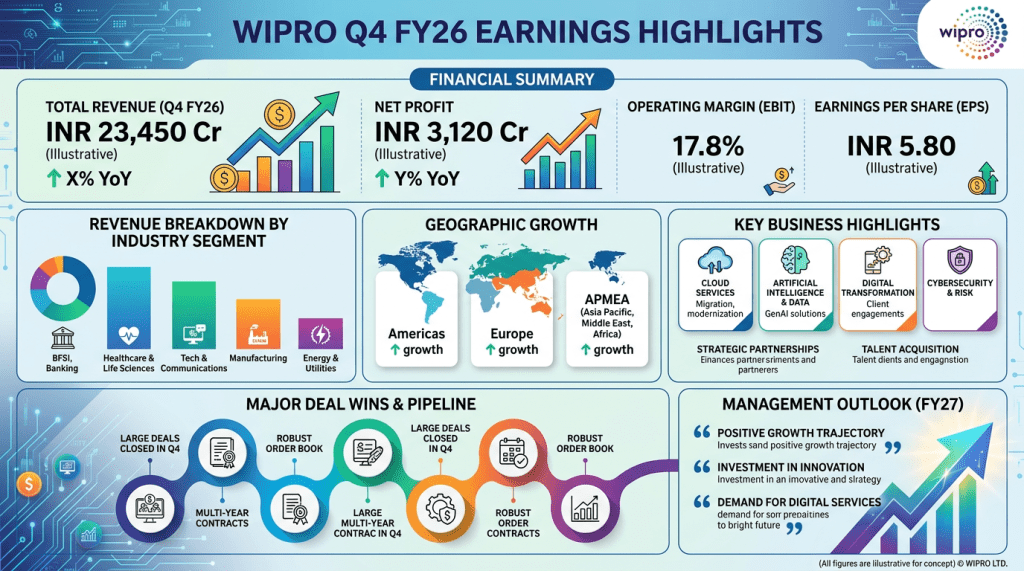
Wipro closed FY26 with modest growth and a stable operating line, but margins stayed under pressure. The March quarter (Q4 FY26) showed healthy top-line momentum, yet net profit inched down as delivery costs rose and treasury income softened. Working capital stretched a bit, while goodwill jumped—pointing to acquisitions.
Quick Summary: Wipro Results
- Q4 revenue at ₹242,363 mn ↑ 7.7% YoY; FY26 revenue at ₹926,240 mn ↑ 4.0%
- Q4 net profit ₹35,216 mn ↓ 1.9% YoY; FY26 net profit ₹132,655 mn ↑ 0.4%
- Margins mixed: gross margin ↓, operating margin broadly flat; lower effective tax rate supported FY profit
- Balance sheet: receivables/unbilled ↑, contract liabilities ↑, goodwill ↑ (acquisitions), short-term debt ↑
Wipro Financial Highlights
|
Q4 FY25 |
Q4 FY26 |
YoY |
| Revenue |
₹225,042 mn |
₹242,363 mn |
+7.7% |
| Operating profit (EBIT) |
₹39,087 mn |
₹41,963 mn |
+7.4% |
| Operating margin |
17.4% |
17.3% |
Flat |
| Net profit |
₹35,881 mn |
₹35,216 mn |
-1.9% |
| EPS (Basic) |
₹3.41 |
₹3.34 |
-2.1% |
|
FY25 |
FY26 |
YoY |
| Revenue |
₹890,884 mn |
₹926,240 mn |
+4.0% |
| Gross profit |
₹273,082 mn |
₹270,048 mn |
-1.1% |
| Operating profit (EBIT) |
₹151,271 mn |
₹151,251 mn |
Flat |
| Net profit |
₹132,180 mn |
₹132,655 mn |
+0.4% |
| Effective tax rate |
~24.5% |
~23.5% |
Lower |
|
Mar 31, 2025 |
Mar 31, 2026 |
YoY |
| Cash & current investments |
₹533,448 mn |
₹543,235 mn |
+1.8% |
| Receivables + Unbilled |
₹182,025 mn |
₹212,724 mn |
+16.9% |
| Contract liabilities |
₹20,063 mn |
₹25,434 mn |
+26.8% |
| Total debt (short + long) |
₹161,817 mn |
₹167,874 mn |
+3.7% |
| Goodwill |
₹325,014 mn |
₹387,399 mn |
+19.2% |
Why Key Numbers Changed (Important Insight)
- Revenue vs Profit: Revenue grew +7.7% YoY in Q4 and +4.0% for FY26, but Q4 profit dipped -1.9% and full-year profit rose only +0.4%. The gap came from lower gross margins and lower other income offsetting operating cost savings.
- Margin moves: Gross margin fell to about 29.1% in Q4 (from ~30.9%) and to 29.2% for FY26 (from ~30.7%). Likely drivers include wage inflation, higher onsite mix, and amortization from newly acquired intangibles. Operating margin held near 17% in Q4 as S&M and G&A were kept tight.
- Other income drag: Finance and other income in Q4 was ₹8,387 mn vs ₹11,819 mn last year, a notable ↓. Lower yields/mark-to-market on investments and hedges can explain the decline, pulling down PBT despite stable EBIT.
- Taxes helped FY26: The effective tax rate fell to ~23.5% (from ~24.5%), cushioning net profit for the year even as margins softened.
- One-time/technical items: Equity rose on large FX translation gains in OCI (non-P&L). Goodwill jumped +19%, indicating acquisitions. No material one-off gain/loss is evident in P&L; hedge valuation swings largely sat in OCI, not in profit.
Operational Performance & Business Trends
- Cost discipline: Q4 selling and marketing and G&A costs fell YoY in absolute terms, improving opex efficiency even as delivery costs rose.
- Delivery intensity: Higher cost of revenue suggests a heavier onsite footprint and/or wage resets. Utilization and pyramid actions will be key to reclaim gross margin.
- Bookings/revenue visibility: Contract liabilities rose +26.8%, a positive signal for near-term delivery schedules and advance billings.
- Working capital: Receivables and unbilled rose +16.9%, ahead of revenue growth. This can temporarily weigh on operating cash flow until collections catch up.
- M&A and capability build: The goodwill and intangible uptick points to acquisitions—likely adding skills in high-demand areas. Integration costs and amortization can weigh near term while strengthening the portfolio long term.
Management Commentary (Simplified)
- Focus on profitable growth: Keep investing in capabilities while staying tight on overheads to defend EBIT margins.
- Integration and execution: Consolidate recent acquisitions to cross-sell and improve deal sizes, accepting some short-term margin drag.
- Hedging and currency: Maintain hedge cover; valuation changes may move through OCI, but the aim is to reduce earnings volatility.
- Working capital discipline: Improve collections and billing cadence to convert revenue growth into cash flow.
Key Positives
- Top-line recovery in Q4 with revenue ↑ 7.7% YoY
- Operating profit held steady; Q4 EBIT up in line with revenue
- Lower effective tax rate supported FY26 bottom line
- Contract liabilities up, improving visibility
- Equity strengthened via positive OCI from currency translation
Key Concerns
- Gross margin compression despite growth; recovery path depends on mix/utilization
- Other income ↓ weighing on PBT; treasury returns less supportive
- Receivables and unbilled rising faster than revenue—watch cash conversion
- Debt profile shift toward short-term; refinancing/execution risk if rates stay elevated
- Goodwill build-up increases sensitivity to any future impairment if growth slows
Final Takeaway for Investors
Wipro delivered a stabilizing year: revenue grew modestly and EBIT held, but delivery costs squeezed gross margin and lower other income dampened profit momentum. Balance sheet remains solid with ample liquid assets, though working capital needs attention. If management improves mix and utilization while integrating recent acquisitions, margins can heal. Near term, expect steady but measured progress rather than a sharp turnaround. Valuation and deal momentum will be key swing factors.
FAQs
- What is revenue? It’s the total money earned from services delivered in the period. Wipro reported ₹242,363 mn in Q4 and ₹926,240 mn for FY26.
- What is profit? It’s what remains after all costs, interest, and taxes. Wipro’s net profit was ₹35,216 mn in Q4 and ₹132,655 mn for FY26.
- Why did profit change even when revenue grew? Delivery costs rose faster than revenue, squeezing gross margin, and “other income” was lower. A reduced tax rate helped full-year profit, but Q4 felt the margin and treasury drag.
- Were there any one-time items? No major P&L one-offs are evident. FX hedge and investment valuation changes mostly flowed through OCI (impacting equity, not profit). Higher goodwill indicates acquisitions that can add short-term costs.
- Is it a good stock to buy? It depends on your view of margin recovery, cash conversion, and deal momentum versus current valuation. The set-up is balanced: improving visibility but ongoing margin work. Consider your risk tolerance and consult a financial adviser.
Disclaimer
This post is for educational purposes only.