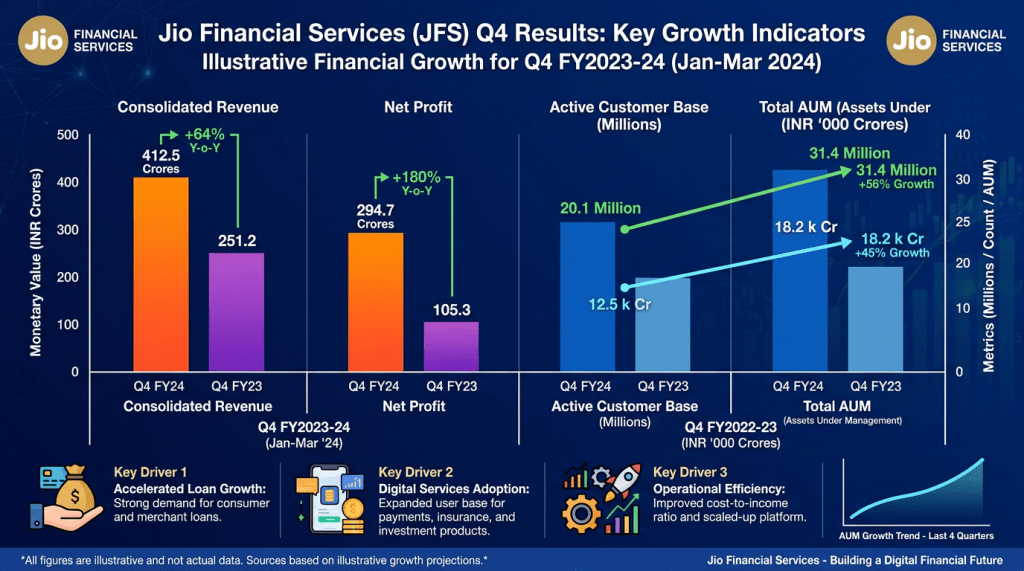
Jio Financial Services posted a mixed-but-encouraging set of numbers: the core franchise is scaling fast while headline profit was weighed down by strategic investments and the consolidation of the payments bank. The message for investors is clear—topline quality is improving as the business tilts from treasury-led income to operating income, but near-term profitability is being consciously traded for growth.
Quick Summary: Jio Financial Results
- Core operating income jumped to Rs. 1,390 crore in FY26 (↑ 272% YoY) as lending, payments and distribution scaled
- Consolidated total income (ex-dividend) declined ↓ 13% YoY due to weaker treasury gains and a higher capital base
- Lending engine accelerated: Jio Credit AUM crossed Rs. 25,700 crore; Q4 disbursements at Rs. 10,629 crore (↑ 49% YoY)
- Board announced dividend of Rs. 0.60/share; payments bank now fully consolidated from June 18, 2025
Jio Financial Financial Highlights
- Consolidated performance
- Total income (ex-dividend): ↓ 13% YoY in FY26 (pressure from treasury and market volatility)
- Pre-provision operating profit (ex-dividend): Under pressure due to consolidation of payments bank losses and growth investments
- Net income from business operations: Rs. 1,390 crore in FY26, ↑ 272% YoY; now 54% of consolidated net total income (vs 20% in FY25)
- Lending (Jio Credit Limited, JCL)
- AUM (Q4 FY26): Rs. 25,711 crore (growth driven entirely by organic originations)
- Q4 FY26 disbursements: Rs. 10,629 crore (↑ 49% YoY)
- Average cost of borrowing: 7.00% (vs 6.99% in Q3 FY26)
- Capital adequacy ratio (Mar 31, 2026): 25.91%; Shareholders’ equity: Rs. 7,163 crore
- Income momentum: Q4 FY26 NII Rs. 202 crore (Q4 FY25: Rs. 81 crore); FY26 NII Rs. 625 crore
- Platform and new businesses
- Jio Finance app: 1.7 million downloads since launch
- Payments Bank: UPI cash withdrawal launched; now consolidated line-by-line
- Payment Solutions: RBI payment aggregator—cross-border license secured
- Asset Management: In-principle nod to set up retail FME in GIFT City (JioBlackRock)
- Allianz JVs: Reinsurance JV received regulatory approval in March 2026
- Shareholder return
- Proposed dividend: Rs. 0.60 per share for FY26
Why Key Numbers Changed (Important Insight)
- Revenue vs Profit:
- Revenue (ex-dividend) eased because treasury gains fell amid geopolitical volatility on a larger capital base.
- Profit (PPOP) was additionally dragged by two strategic choices—consolidating the payments bank’s operating loss and funding scale-up of early-stage businesses.
- Core mix improving:
- Core operating income surged to Rs. 1,390 crore, showing that lending, payments and distribution are replacing historically volatile dividend/treasury income.
- Margins and costs:
- Lending spreads broadly held up, but the 7.00% cost of funds and higher operating expenses (tech, talent, distribution) compressed near-term PPOP.
- As volumes scale and the payments bank stabilizes, unit economics should improve—but that takes a few quarters.
- One-time/structural items:
- From June 18, 2025, Jio Payments Bank moved from “share of JVs/associates” to full consolidation—this changed reported profitability trends even though underlying operations are the same.
Operational Performance & Business Trends
- Lending
- Growth led by mortgages (home loans, LAP), loan against securities, and selective corporate lending.
- Distribution deepening across key cities; entirely organic origination growth supports asset quality control and pricing.
- Payments and Merchant Solutions
- UPI cash withdrawal and cross-border acquiring capabilities broaden use cases for consumers and merchants.
- Focus on reliable settlements and compliance—a differentiator for enterprise clients.
- Invest & Protect
- AMC build-out (JioBlackRock) progressing—GIFT City approval expands the product shelf for domestic and global offerings.
- Insurance distribution scaling; reinsurance JV with Allianz adds institutional depth ahead of full-stack insurance launches.
- Digital marketplace
- AI-native, conversational finance layer aims for “N=1” personalization—early traction with 1.7 million downloads shows demand for unified financial journeys.
Management Commentary (Simplified)
- We’re prioritizing scale in core businesses even if it pressures near-term P&L.
- Market volatility hurt treasury income; hence the sharper push to operating income (lending, payments, distribution).
- Payments Bank consolidation is deliberate—better control, faster product rollouts, but near-term losses will reflect in results.
- Risk remains measured: solid capital adequacy at JCL and diversified funding help navigate a rising-rate backdrop.
Key Positives
- ↑ Strong core momentum: operating income at Rs. 1,390 crore, now over half of consolidated net total income
- ↑ Lending scale-up: AUM at Rs. 25,711 crore, high disbursement velocity, and stable funding costs
- ↑ Strategic licenses/approvals across payments, AMC, and reinsurance lay a multi-year growth runway
- ↑ Healthy capital at the NBFC (CAR 25.91%) supports growth without stretching the balance sheet
Key Concerns
- ↓ Treasury income volatility continues to cloud headline revenue and PPOP
- ↓ Payments bank consolidation brings near-term operating losses into the P&L
- ↓ Slight uptick in funding costs (7.00%) amidst rising yields; sustained increase could pressure spreads
- ↓ Execution complexity across multiple new verticals (AMC, re/insurance, cross-border payments) needs tight risk and compliance controls
Final Takeaway for Investors
Jio Financial is clearly transitioning from market-linked income to a steadier, operating-income-led model. That’s healthy for long-term quality of earnings. However, the journey brings short-term P&L friction from payments bank consolidation, upfront tech/distribution costs, and choppy treasury gains. For investors with a multi-year view, the expanding product stack, regulatory milestones, and lending scale are constructive. Near-term traders should expect earnings variability while the platform matures.
FAQs
- What is revenue?
- Here, revenue refers to total income (excluding dividend in the disclosed metric), which includes interest, fees, commissions, and treasury-related income.
- What is profit?
- Profit is what remains after expenses. A common operating profit metric is PPOP (pre-provision operating profit), which excludes credit provisions and taxes.
- Why did profit change this quarter/year?
- PPOP fell due to consolidation of payments bank losses, higher operating spend to scale new businesses, and weaker treasury gains from market volatility.
- How is the lending business doing?
- Strong. AUM reached Rs. 25,711 crore, Q4 disbursements were Rs. 10,629 crore, and the average cost of borrowing was 7.00%, indicating healthy scale-up with stable funding.
- Is this a good stock to buy?
- It depends on your horizon and risk appetite. Long-term investors may like the shift to core operating income and platform optionality. Short-term investors should be ready for earnings swings as the company invests for growth. Always do your own research or consult an advisor.
Disclaimer
This post is for educational purposes only.


