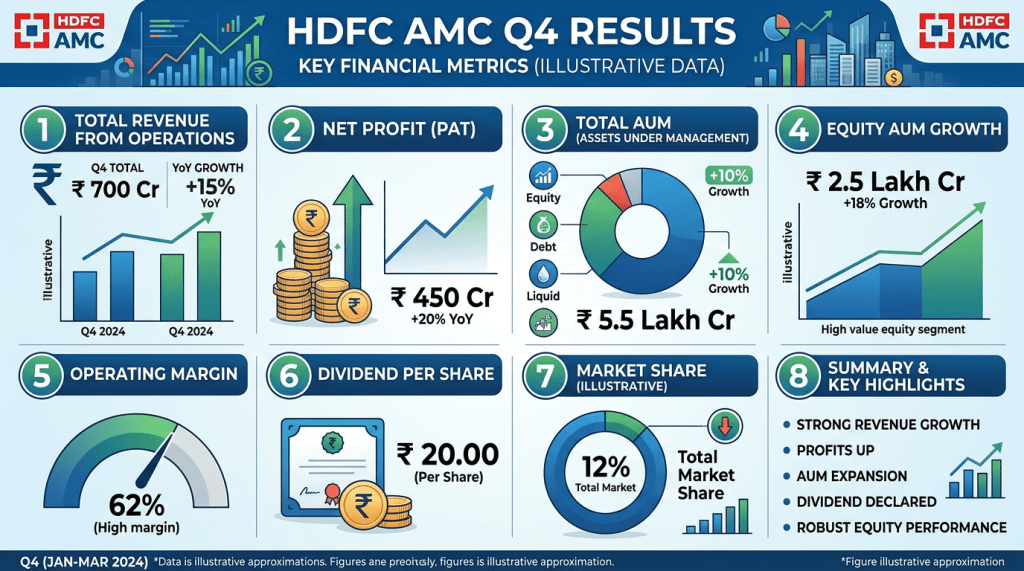
Quick Summary: HDFC Asset Management Company Results
- Board approved audited standalone and consolidated results for Q4 FY26 and FY26; auditors issued an unmodified (clean) opinion.
- Recommended a final dividend of Rs. 54 per share (face value Rs. 5), subject to shareholder approval at the AGM.
- Detailed financial statements are available in Annexure A on the company’s website; the exchange note above does not list revenue/profit/AUM figures.
- Key variables to watch in the full results: average AUM mix, fee yields, operating margin, and other income from treasury.
HDFC Asset Management Company Financial Highlights
Period covered: Quarter and year ended March 31, 2026 (audited)
Dividend: Final dividend of Rs. 54 per equity share (FV Rs. 5), post AGM approval
Audit opinion: Unmodified (clean) from B S R & Co. LLP
Status: Results approved on April 16, 2026; detailed schedules in Annexure A on the company website
- Revenue, Profit, EPS, Average AUM, and Operating Margin: Not disclosed in the text above. Refer the full audited results to see the exact numbers.
Why Key Numbers Changed (Important Insight)
- Revenue drivers (what to check): For AMCs, revenue primarily comes from management fees on AUM. Two things move it:
- AUM growth and mix – Equity AUM usually carries higher yields than debt/liquid; passive/ETFs carry lower yields.
- Fee yield (TER/IMF) – Competitive pricing and a higher share of direct plans can compress yields.
- Profit vs. revenue difference: Profit is revenue minus operating costs plus/minus other income. Two AMCs with the same revenue can report different profits depending on:
- Operating leverage – Costs (people, tech, distribution) spread over a larger AUM base can lift margins.
- Other income – Treasury income and mark-to-market gains/losses can swing quarterly PAT even if fee revenue is steady.
- One-time items to watch:
- Exceptional legal/regulatory expenses, ESOP fair-value charges, tech write-offs, or investment MTM impacts can distort a single quarter.
- Margin changes (why they move):
- Mix shift toward equity usually helps margins; a move to passive or liquid funds can dilute margins.
- Cost timing (annual appraisals, marketing campaigns, tech rollouts) may bunch up in Q4.
- Yield pressure from competition or a higher share of direct plans can compress gross margins even if AUM rises.
Operational Performance & Business Trends
- Equity franchise: Sustained SIP flows typically support equity AUM and higher yields. Fund performance versus benchmarks drives flows and market share.
- Debt and liquid: Sensitive to interest-rate cycles and corporate treasury behavior. Post-tax rules for debt funds have structurally altered investor preference; check if institutional flows offset retail softness.
- Passives: ETFs/index funds keep gaining share industry-wide. Good for scale; yields are lower, so watch the margin impact.
- Distribution: HDFC brand and bank-linked distribution are strengths; also track direct plan penetration and B-30 (beyond top-30 cities) momentum.
- Digital and operating efficiency: Investments in digital onboarding, investor experience, and data/analytics can lift scalability and protect margins.
Management Commentary (Simplified)
- A clean audit and a high final dividend signal confidence in cash generation and balance-sheet strength.
- Focus areas (based on industry context and the company’s usual priorities):
- Maintain competitive investment performance to sustain equity flows and SIP book.
- Broaden product mix in passives while defending margins through scale and cost control.
- Keep investing in technology, compliance, and investor experience to deepen market share.
- Expect commentary on AUM mix, fee yields, market-share trends, and any regulatory changes affecting TERs and distribution.
Key Positives
- Strong shareholder return via proposed final dividend of Rs. 54/share, indicating robust cash flows.
- Unmodified audit opinion reduces accounting/quality concerns.
- Structural tailwinds from financialization of savings and sticky SIP culture in India.
- Potential operating leverage if equity AUM mix stays favorable and costs scale efficiently.
- Brand strength and distribution reach typically support resilience across cycles.
Key Concerns
- Fee pressure from regulation, competition, and higher direct-plan share can compress yields.
- Passive growth is a double-edged sword: scale ↑, yield ↓.
- Market volatility can swing flows, AUM, and treasury income, impacting quarterly PAT.
- Concentration risk if flows are tied to a few flagship equity schemes; performance slippage can hurt.
- Any regulatory changes in distribution/TER or tax treatment could reshape product economics.
Final Takeaway for Investors
HDFC AMC’s board has cleared the FY26 audited results with a clean opinion and proposed a sizable final dividend—both are reassuring signals. The real story, however, sits in the details: average AUM growth, equity mix, fee yields, and operating margins. If equity performance and SIP flows held up, FY26 should reflect healthy operating leverage; if passives and direct share rose faster, yields may be softer. Review the full numbers in Annexure A before making a call, and weigh them against valuation. Long-term fundamentals of the franchise remain solid, but monitor yield trends and market-share shifts closely.
FAQs
- What is revenue for an AMC?
Revenue mainly comes from investment management fees charged on the mutual funds’ average AUM. Lower-yield products (like ETFs/liquid) reduce revenue per rupee of AUM. - What is profit for an AMC?
Profit is revenue minus operating expenses plus other income (treasury/MTM). It reflects both business performance and market-linked treasury outcomes. - Why did profit change versus last year/quarter?
Usually due to a mix of AUM growth/mix, fee-yield changes, cost timing (appraisals, marketing, tech), and swings in other income from interest rates/market MTM. - What does the Rs. 54 dividend mean?
It’s a proposed final payout per share (FV Rs. 5), subject to AGM approval. It signals strong cash generation. The yield depends on the market price on the record date. - Is HDFC AMC a good stock to buy?
It depends on valuation and the latest numbers. Check equity AUM momentum, fee yields, operating margins, and market share. If the stock already prices in strong growth, returns may hinge on sustained outperformance.
Disclaimer
This post is for educational purposes only. It is not investment advice or a recommendation to buy/sell any securities. Please read the full audited results and consult a registered advisor before investing.


