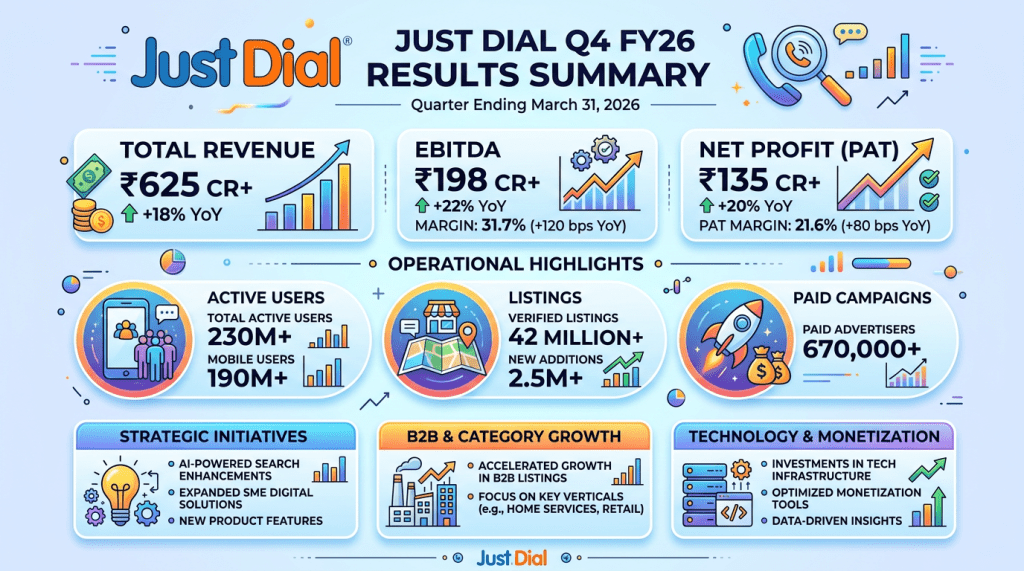
Quick Summary: Just Dial Results
- Q4 FY26 unique visitors at 182.4 million (↓ vs 184.5 million in Q3) – slight softness in traffic.
- 631,530 active paid campaigns – monetization base intact.
- Platform remains mobile-first: 85.7% of traffic from mobile apps/website ↑ scalability.
- Rich content moat: 54.7 million listings and 157.1 million ratings/reviews support trust and conversions.
Just Dial Financial Highlights
Note: The corporate presentation shared operating metrics but did not include revenue, EBITDA or PAT figures. Below are the key drivers that typically shape financials.
- Business model: Prepaid, subscription-led advertising for SMEs; premium and non-premium listing packages; add-ons like banners, website builder, JD Pay, and ratings tools.
- Monetization base (Q4 FY26): 631,530 active paid campaigns; national and multi-city campaigns for larger advertisers.
- Traffic & reach (Q4 FY26): 182.4 million unique visitors (Q/Q ↓ from 184.5 million); mobile share 85.7%, desktop 11.5%, voice 2.8%.
- Content depth: 54.7 million listings; 157.1 million ratings & reviews enhance credibility and conversion.
- Distribution: On-ground presence in 250+ cities across 11,000+ pin codes; sales engine of 5,122 telesales and 5,350 feet-on-street reps.
- Working capital: Prepaid model typically supports cash flows and reduces credit risk vs. pay-later ad models.
Why Key Numbers Changed (Important Insight)
- Traffic softness Q/Q: The slight decline to 182.4m likely reflects normal seasonality, algorithmic shifts, or tougher comparisons. For a directory-style business, even small traffic moves can affect lead volumes and campaign renewals.
- Revenue vs. profit: Revenue is driven by the number of active paid campaigns and average revenue per campaign (package mix, city tiers, add-ons). Profit moves differently because it absorbs fixed and variable costs (sales hiring, marketing, tech, customer support), so margins can expand or compress even if revenue is flat.
- Margins: A mobile-heavy mix and telesales leverage usually support margins. However, increased spending on sales feet-on-street, brand marketing, or new product builds (JD Mart, JD Omni, JD Xperts) can lower near-term margins to seed future growth.
- One-time items: Not specified in the deck. Typically, items like provisions/write-offs, legal/settlement costs, ESOP charges, or tax adjustments can swing reported profit in a given quarter without reflecting core operating momentum.
- Churn and ARPC dynamics: Upgrades to premium placements and cross-selling add-ons can lift ARPC; SME budget cuts or higher churn can offset that. The active paid campaign count and renewal rates are key indicators to watch.
Operational Performance & Business Trends
- Mobile-first discovery: With 85.7% of traffic from mobile, the company benefits from lower friction and better engagement via app notifications, location detection, voice search, and maps.
- Trust and conversion: 157.1m verified ratings and reviews, photos, and performance tags help users pick the right vendor, improving lead quality for SMEs.
- SME digitization stack: Beyond search, tools like website builder, JD Pay, JD Ratings, JD Omni (cloud solution), and JD Xperts deepens wallet share and stickiness.
- B2B push: JD Mart targets wholesale buyers and suppliers, expanding from local discovery to transactions and quotes – a potential ARPC and category depth driver if scaled well.
- Distribution muscle: Presence in 250+ cities and a large salesforce support penetration into Tier 2/3 markets, where SME digitization is still ramping.
Management Commentary (Simplified)
- They are leaning on their first-mover brand, deep listings, and a scalable tech stack to keep monetizing local search.
- Focus remains on improving advertiser ROI via better placements, richer profiles, and ratings – to boost renewals and upgrades.
- Investments in product (JD Mart, Omni, Xperts) and sales reach are near-term costs intended to widen the long-term opportunity.
- Prepaid model and disciplined execution are positioned as strengths for predictable cash flows.
Key Positives
- Large, sticky ecosystem: 54.7m listings and 157.1m reviews create network effects and defensibility.
- Monetization base intact with 631k+ active paid campaigns; add-ons provide ARPC upside.
- Mobile-led traffic (85.7%) supports scale with relatively low incremental cost per user.
- Prepaid model generally means lower receivable risk and healthier cash conversion vs. typical ad businesses.
- Broad on-ground coverage across India positions the firm well for SME digitization in smaller cities.
Key Concerns
- Q/Q traffic dip (↓) needs monitoring; repeated softness could pressure lead volumes and renewals.
- Intense competition from search platforms and maps could cap pricing power or increase acquisition costs.
- SME ad budgets are cyclical; macro weakness can raise churn or push downgrades.
- Newer initiatives (JD Mart, Omni, Xperts) carry execution risk and may weigh on margins before scale.
- Limited visibility on exact quarterly financials in the deck; investors should watch the official results release for revenue, ARPC, margin and cash metrics.
Final Takeaway for Investors
Just Dial remains a high-reach, mobile-first local discovery platform with a sizable monetization base and a cash-friendly prepaid model. The slight Q/Q traffic dip makes the next couple of quarters important: investors should look for stabilization or re-acceleration in visitors, growth in active paid campaigns and ARPC, and clarity on margin trajectory as sales and product investments continue. Long-term story is intact, but near-term performance will hinge on execution and competitive dynamics.
FAQs
- What is revenue?
Revenue is the money the company earns from advertisers (mostly SMEs) who pay for listings, premium placements, and add-on services like banners, website builder, JD Pay, and ratings tools. - What is profit?
Profit is what remains after subtracting all expenses (sales, marketing, employee costs, technology, server/infra, admin, taxes, etc.) from revenue. It shows how efficiently the company turns sales into earnings. - Why did profit change?
Even if revenue is steady, profit can move due to spending on sales hiring, marketing, product development, technology depreciation, provisions/write-offs, or tax adjustments. One-time items can also swing profit temporarily. - Is this a good stock?
It depends on your risk profile. Positives include scale, prepaid model, and mobile-first usage. Key watch-outs are traffic trends, competition, and execution in new products. Review the official results (revenue, margins, cash) and your investment horizon before deciding. - How does Just Dial grow revenue?
By adding more paid advertisers, improving renewal rates, upselling higher-tier packages and add-ons, and expanding into new categories and geographies (including Tier 2/3 markets).
Disclaimer
This post is for educational purposes only and is not investment advice. Figures referenced are from the company’s April 2026 investor materials where available; please read the official results and consult a financial advisor before making investment decisions.


