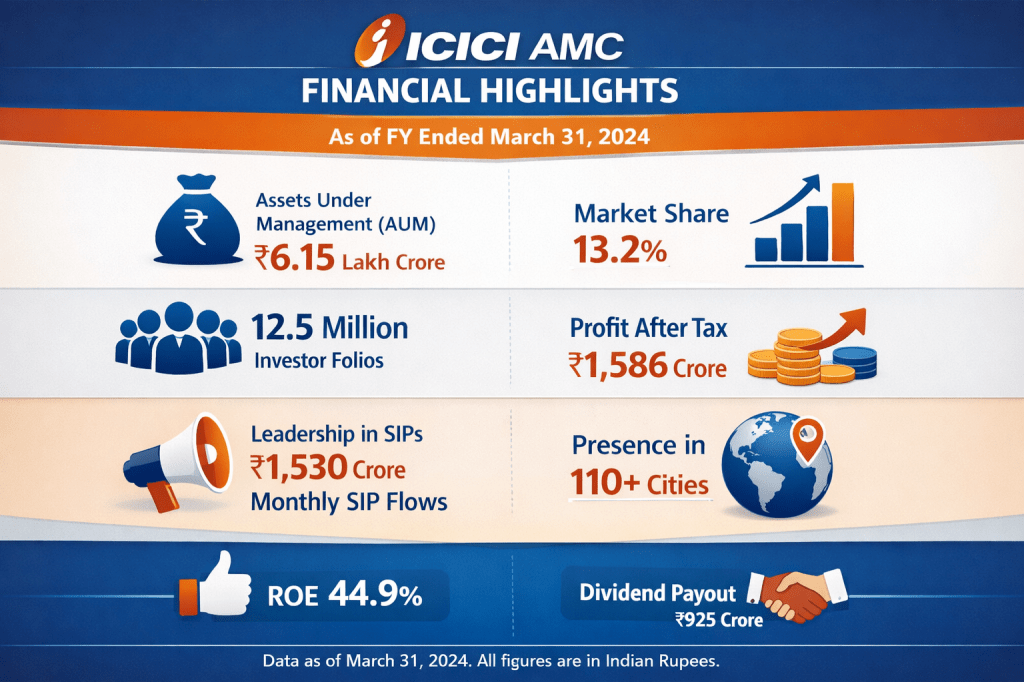
ICICI Prudential AMC posted a steady quarter on the top line while the bottom line softened. AUM mix continued to tilt toward equity and passives, keeping long-term earnings power intact. The near-term dip in profit looks more about treasury/tax and seasonality than about the core franchise.
Quick Summary: ICICIAMC Results
- Operating revenue at ₹15.2 bn (Q-o-Q ↑ 0.2%) — broadly stable despite volatile debt markets
- Operating profit at ₹11.3 bn (Q-o-Q ↑ 2%) — slight margin lift on cost discipline
- PAT at ₹7.6 bn (Q-o-Q ↓ 17%) — impacted by non-operating items/taxes
- Total MF QAAUM at ₹11.05 tn (Q-o-Q ↑ 2.6%); Equity QAAUM at ₹6.20 tn (Q-o-Q ↑ 2.0%)
ICICIAMC Financial Highlights
| Operating Revenue (Q4FY26) | ₹15.2 bn (Q-o-Q +0.2%) |
| Operating Profit – Before Tax (Q4FY26) | ₹11.3 bn (Q-o-Q +2%) |
| Profit After Tax (Q4FY26) | ₹7.6 bn (Q-o-Q -17%) |
| Total MF QAAUM (Mar-26) | ₹11,047.87 bn (Q-o-Q +2.6%, Market share 13.5%) |
| Active MF QAAUM (Mar-26) | ₹9,206.15 bn (Q-o-Q +1.3%, Market share 13.7%) |
| Equity Schemes QAAUM (Mar-26) | ₹6,204.01 bn (Q-o-Q +2.0%, Market share 14.2%) |
| Equity Hybrid QAAUM (Mar-26) | ₹2,177.97 bn (Q-o-Q +4.5%, Market share 26.7%) |
| Passive QAAUM (Mar-26) | ₹1,241.83 bn (Q-o-Q +10.0%) |
| Liquid QAAUM (Mar-26) | ₹699.29 bn (Q-o-Q +5.7%) |
| Debt QAAUM (Mar-26) | ₹1,990.56 bn (Q-o-Q -2.7%) |
| Revenue Yield (TTM) | 0.52% |
| OPBT Yield (TTM) | 0.38% |
| ROE (TTM) | 85.8% |
| Customer Base (Mar-26) | 17.0 mn (Q-o-Q +5.0%) |
Why Key Numbers Changed (Important Insight)
- Revenue: Modest ↑ 0.2% despite a tough debt quarter. Equity and passive AUM rose, supporting fees, while debt QAAUM dipped, capping upside on blended yields.
- Operating profit: ↑ 2% Q-o-Q as operating costs stayed tight. With revenue flat, this implies a small margin improvement, helped by mix and cost control.
- Profit vs revenue: PAT fell ↓ 17% even as revenue/OP rose. That gap typically comes from below-OP items — treasury mark-to-market, other income volatility, or a higher effective tax rate. The deck doesn’t flag a specific one-off; expect detailed schedules in the full results.
- Margins: With OP growing faster than revenue, core operating margin inched up. TTM revenue and OPBT yields of 0.52%/0.38% on AUM remain healthy for a scaled AMC.
- One-time items: None explicitly disclosed. Seasonally, Q4 can see higher variable pay/brand spends and treasury swings, which can temporarily pressure PAT.
Operational Performance & Business Trends
- Equity engine steady: Equity QAAUM rose to ₹6.2 tn (Q-o-Q +2.0%), supported by improving net sales and strong SIP discipline industry-wide. Equity hybrid also advanced to ₹2.18 tn (Q-o-Q +4.5%).
- Passives gaining traction: Passive QAAUM jumped 10% Q-o-Q to ₹1.24 tn, reflecting investor adoption of ETFs/Index funds and institutional mandates.
- Liquidity pockets improved: Liquid funds QAAUM rose 5.7% Q-o-Q to ₹699 bn, while debt funds contracted 2.7% Q-o-Q amid rate and duration caution.
- Alternates scaling selectively: PMS stood at ₹268 bn; AIF at ₹170 bn. Assets under advisory reached ₹291 bn. The focus is “boutique within an institution” — higher-alpha strategies with governance and distribution muscle.
- Distribution breadth: Over 114,000 distributors and 281 offices (incl. Dubai, GIFT City). Equity QAAUM mix remains well diversified across direct, MFDs, banks and national distributors — helpful for resilient flows.
- Digital-first ops: Expanded AI-led tools, investor portals and automation across onboarding, service and risk control — key for scale without proportional costs.
- Global/IFSC push: DIFC office live; two specialized iSIF funds launched in GIFT City in Jan-26 with AUM of ₹18.96 bn by Mar-26 — opening new pools of capital.
Management Commentary (Simplified)
- Customer first: Prioritize long-term investor outcomes (systematic, diversified portfolios) over short-term asset gathering.
- Profitable growth: Expand equity, hybrid, and passives while keeping a sharp eye on costs and operating leverage.
- Low risk to brand/shareholders: Stick to compliant, process-driven investing with robust risk systems; avoid chasing yield.
- Strategic expansion: Build alternates thoughtfully and tap global/IFSC platforms to diversify products and investors.
Key Positives
- Strong equity and hybrid market shares (14.2% and 26.7%) and rising passive scale support durable fees.
- High TTM ROE of 85.8% underscores the asset-light, cash-generative model.
- Broad, deep distribution and growing 17 mn customer base improve flow visibility.
- Digital and data stack enables efficient growth and better risk oversight.
- Diversification via alternates and IFSC/DIFC platforms adds optionality.
Key Concerns
- Short-term PAT volatility from treasury MTM/other income can mask core strength.
- Debt AUM softness and cyclical liquid flows can weigh on blended yield in certain quarters.
- Industry fee pressure (especially in passives) may cap yield expansion over time.
- Regulatory changes and competition from peers/fintechs remain ongoing risks.
Final Takeaway for Investors
ICICI Prudential AMC delivered a resilient quarter operationally: equity-led AUM growth, improving passives, and steady core margins. The PAT drop looks more cyclical/non-operating than structural. For long-term investors following AMC businesses, the franchise quality — scale, brand trust, distribution, and tech — remains intact. Near-term earnings swings are part of the model; the medium-term story rides on sustained SIPs, equity market depth, and disciplined costs.
FAQs
- What is revenue? It’s the fee income the AMC earns on managing investor assets (AUM). For Q4FY26, operating revenue was ₹15.2 bn.
- What is profit? Profit After Tax (PAT) is what remains after operating costs, other income/expenses, and taxes. Q4FY26 PAT was ₹7.6 bn.
- Why did profit change more than revenue? PAT fell despite flat revenue because items below operating profit (like treasury mark-to-market and taxes) likely moved adversely this quarter. The company didn’t disclose a specific one-off in the deck.
- What drove margins? Operating profit rose faster than revenue, indicating modest margin expansion from mix (more equity/passives) and cost control.
- Is it a good stock to buy? AMCs benefit from operating leverage and high ROE, but face market/regulatory cyclicality. The investment call depends on valuation versus peers and your risk tolerance. Evaluate fundamentals, fees, growth visibility and industry dynamics before deciding.
Disclaimer
This post is for educational purposes only.


