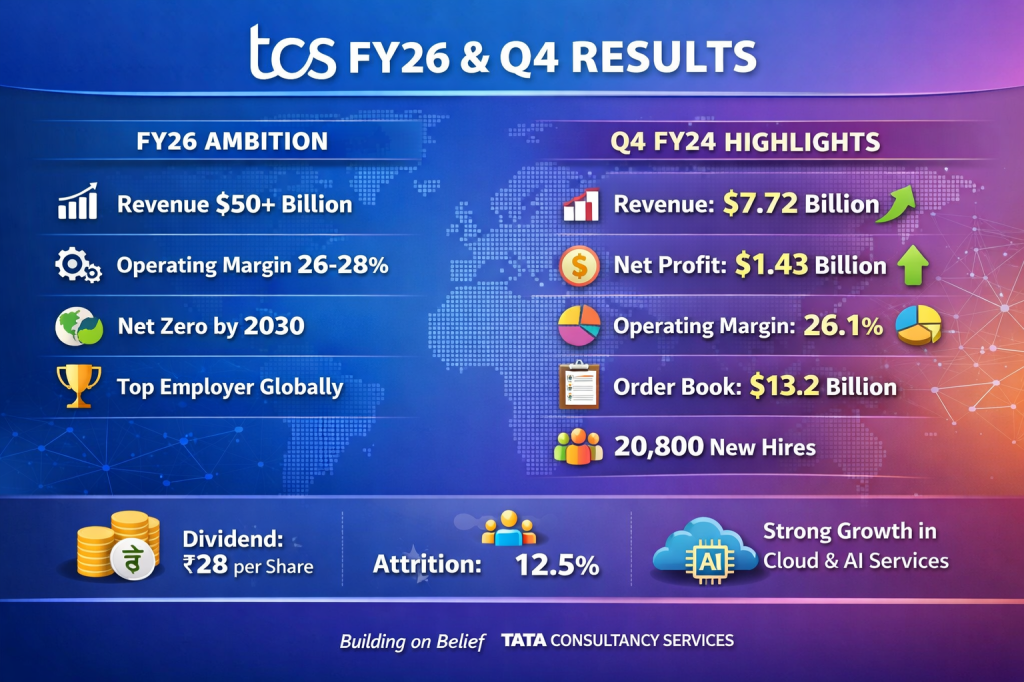
TCS closed FY26 with steady full-year growth and a stronger finish in Q4. Revenue acceleration into year-end suggests better deal ramp-ups and seasonal tailwinds, even as the full-year pace stayed moderate. Cash generation remains robust, and the company’s long history of buybacks continues to support per-share metrics.
Quick Summary: TCS Results
- Q4 FY26 revenue at ₹70,698 crore (↑ 5.4% QoQ; ↑ 9.6% YoY)
- FY26 revenue at ₹2,67,021 crore (↑ 4.6% YoY) — steady but not sizzling
- Q4 other income of ₹757 crore likely cushioned the bottom line
- Equity shares outstanding: 3,61,80,87,518; past buybacks continue to support EPS
TCS Financial Highlights
- Q4 FY26 Revenue from operations: ₹70,698 crore
- Q3 FY25 Revenue from operations: ₹67,087 crore
- Q4 FY25 Revenue from operations: ₹64,479 crore
- FY26 Revenue from operations: ₹2,67,021 crore
- FY25 Revenue from operations: ₹2,55,324 crore
- Q4 FY26 Other income: ₹757 crore
- QoQ growth (Q4 vs Q3): ~5.4%; YoY growth (Q4 vs Q4): ~9.6%; FY growth: ~4.6%
- Capital structure snapshot (as of Mar 31, 2026):
- Paid-up equity capital: 3,61,80,87,518 shares of ₹1 each
- Preference shares: Redeemed in 2014 (nil outstanding)
- Shareholder returns: Five major buybacks completed between 2017 and 2023, repurchasing about 26.7 crore shares in total (prices ranged roughly from ₹2,100 to ₹4,500 per share)
Why Key Numbers Changed (Important Insight)
- Revenue momentum:
- Q4 pickup is typical for IT services due to year-end project ramp-ups and budgeting tailwinds.
- Improved deal execution and vendor consolidation work likely aided the QoQ growth.
- On a full-year basis, growth of ~4.6% reflects a still-cautious demand environment for discretionary projects, especially earlier in the year.
- Profit vs revenue (how they diverge):
- Revenue measures the value of services delivered. Profit also depends on delivery costs (wages, travel, subcontracting), pricing, and utilization.
- Other income of ₹757 crore in Q4 (treasury/FX/interest) lifts profit but does not affect revenue. This can make profit growth look better than operating growth.
- One-time items:
- No explicit one-time/exceptional item is visible in the excerpt. If present, such items typically appear under “exceptional items” or within other income/expenses and can temporarily distort profit.
- Margins (directional drivers to watch):
- Tailwinds: Better utilization in Q4, higher offshore mix, automation, and pyramid optimization.
- Headwinds: Wage hikes, on-site mix, travel normalization, and pricing pressure on legacy work.
- Net impact: With revenue up QoQ, operating leverage usually helps margins, but the actual margin print isn’t disclosed here.
- Per-share effects:
- Past buybacks reduce the share count, supporting EPS even when topline growth is modest.
Operational Performance & Business Trends
- Broad-based drivers (context): Clients continue to prioritize cost takeouts, core modernization, and data/AI programs. Vendor consolidation is favoring large-scale providers.
- Verticals and geographies: The excerpt doesn’t break out segments. Industry-wide in FY26, BFSI remained cautious, while manufacturing, lifesciences, and select government/public sector programs were steadier. North America demand was mixed; Europe comparatively resilient in cost programs.
- Deal execution: Q4 often sees stronger ramps. A healthier exit rate into FY27 matters more than a single-quarter print.
Management Commentary (Simplified)
- What it likely means in plain English:
- Pipeline is healthy, but conversion depends on macro stability.
- Focus stays on productivity (automation, AI), utilization, and pyramid to protect margins.
- Capital return remains a priority given strong cash generation.
- Hiring is calibrated to demand; fresher onboarding and lateral hires are paced to deal ramps.
- Note: The excerpt provided doesn’t include direct quotes; the points above reflect common themes TCS emphasizes each quarter.
Key Positives
- Solid Q4 momentum: ₹70,698 crore revenue with ↑ 5.4% QoQ and ↑ 9.6% YoY growth
- Resilient cash profile: Q4 other income of ₹757 crore underscores a strong treasury position
- Shareholder-friendly capital allocation: Multiple buybacks over the years support EPS
- Diversified service mix and scale advantages help win vendor consolidation mandates
Key Concerns
- Full-year growth of ~4.6% signals that discretionary spending remains subdued
- Pricing pressure in legacy work and potential delays in decision-making can cap margin expansion
- Macro sensitivity (US/Europe) and currency swings could add volatility
- Visibility on pace of AI monetization and cloud modernization spend remains a key watch item
Final Takeaway for Investors
TCS ended FY26 on a stronger note, but the full-year growth pace shows that the IT spending cycle hasn’t fully turned. The combination of robust Q4 revenue, healthy other income, and a disciplined capital return framework keeps the long-term story intact. Near-term stock performance will likely track deal conversions, margin delivery, and signs of a broader discretionary-spend recovery. Quality compounder for patient investors; entry points should consider valuations and macro visibility.
FAQs
- What is revenue?
Revenue is the money TCS earns from delivering services (like application development, cloud, consulting) before expenses are deducted. - What is profit?
Profit is what remains after subtracting costs (employee, subcontracting, travel, overheads), taxes, and other charges from revenue. It can also include “other income” from cash investments and FX. - Why did profit change if revenue was steady?
Profit moves with delivery costs, pricing, utilization, and “other income.” For Q4, the reported ₹757 crore in other income likely supported profit even beyond operating trends. - Were there any one-time items?
The provided excerpt doesn’t show specific exceptional items. If any exist, they would appear under exceptional/other income or expense lines and can temporarily inflate or depress profit. - Is TCS a good stock?
TCS is a high-quality, cash-generative leader. It suits long-term investors seeking stability and dividends/buybacks. Near term, returns depend on demand recovery, margins, and macro conditions. Always assess valuation and your risk profile.
Disclaimer
This post is for educational purposes only. It is not investment advice. Please do your own research or consult a SEBI-registered advisor before investing.


