Intro paragraph
Adani Ports (APSEZ) presented an investor update in February 2026 outlining its scale, recent asset additions and medium-term growth targets. The company is focused on expanding port capacity, logistics assets and digitization while integrating recent acquisitions such as NQXT.
Key Highlights
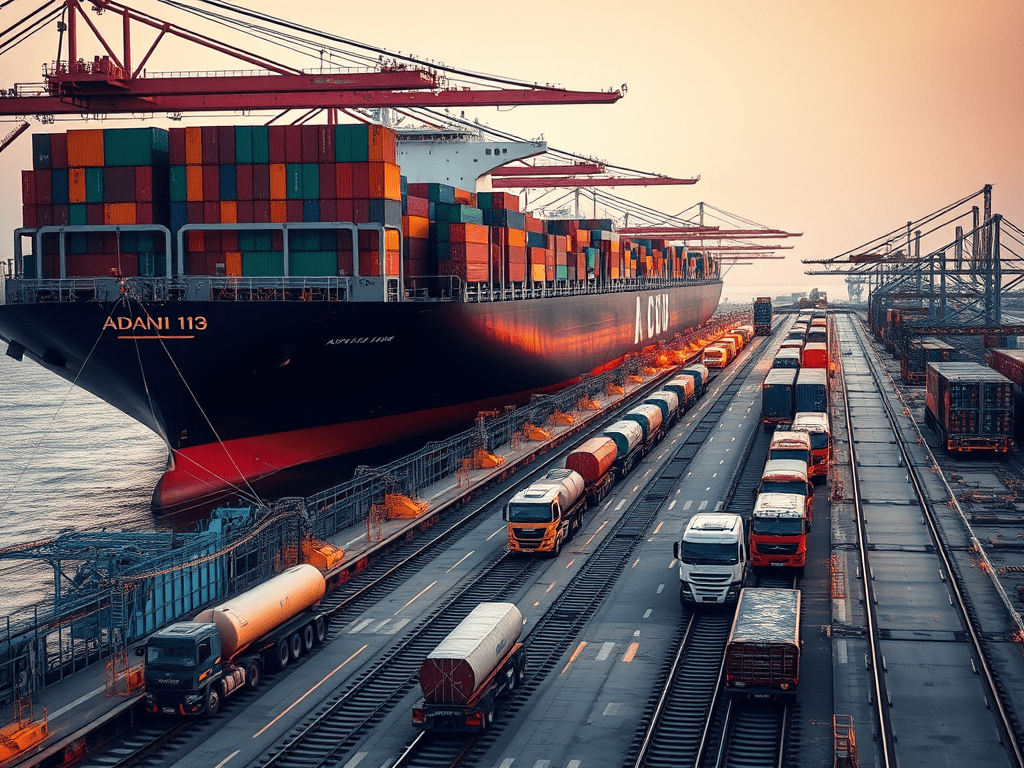
– APSEZ positions itself as an integrated transport utility covering ports, shipping, rail rakes, MMLPs, warehouses and trucking.
– As of Q3 FY26 the network includes 19 ports, 129 vessels, 132 rakes, 12 MMLPs, about 3.1 million sq. ft. of warehousing and 937 trucks.
– India footprint: 15 domestic ports with reported aggregate capacity of 653 MMT.
– Management target: 850 MMT domestic cargo volume by December 2030.
– Sticky cargo (preferred or long-term customers) has historically been high (around 56% in FY22) and was reported at 49% in 9M FY26.
– APSEZ completed the acquisition of North Queensland Export Terminal (NQXT) in December 2025, expanding its international presence.
– Company highlights strong track record of turning around acquired assets (examples cited include Dhamra, Kattupalli, Krishnapatnam, Karaikal).
Financial Summary
| Metric | Current | Previous | Change | Trend |
|---|---|---|---|---|
| Number of ports | 19 (Q3 FY26) | 10 (FY20) | +9 | Up |
| Vessels / Tugs | 129 vessels (Q3 FY26) | 26 tugs (FY20) | Expanded fleet | Up |
| Rakes | 132 (Q3 FY26) | 58 (FY20) | +74 | Up |
| MMLPs | 12 (Q3 FY26) | 5 (FY20) | +7 | Up |
| Warehouse space | ~3.1 Mn sq. ft. (Q3 FY26) | 0.4 Mn sq. ft. (FY20) | +2.7 Mn sq. ft. | Up |
| Trucks | 937 (Q3 FY26) | Not shown (FY20) | New disclosure | Up |
| Domestic port capacity | 653 MMT (15 ports) | — | Reported | Stable / Growing |
Business Performance
APSEZ operates across the full logistics chain. The core business remains port operations and container terminals, which generate the largest portion of value. Surface transport (rakes and trucks), Multi Modal Logistics Parks (MMLPs) and warehousing complement port services and help capture inland cargo flows. International assets in Israel, Tanzania, Sri Lanka and Australia support the global footprint. The company emphasizes a digitized operating model — real‑time rake tracking, terminal operating systems and fleet management — to improve turnarounds and reduce costs. Management also highlights a repeatable playbook for acquiring underutilized ports and improving margins through new equipment, mechanization and added cargo mix.
Management Commentary
Management’s message is straightforward: build scale, lock in long‑term customers and invest in capacity where demand is visible. The deck reiterates the 850 MMT domestic cargo target by 2030, focus on sticky cargo relationships, and continued capital deployment into terminals, MMLPs and related transport assets. The team points to a track record of profitable turnarounds at acquired ports and calls out digitization as a means to improve efficiency and customer service. Recent strategic moves, such as the NQXT buyout, are presented as steps to diversify geography and commodity exposure.
Positives
- Large and growing asset base across ports, logistics parks and transport — supports scale benefits.
- Clear domestic growth target (850 MMT by 2030) and a history of increasing market share.
- High proportion of sticky cargo, which supports predictable volume and pricing.
- Proven ability to improve EBITDA and margins at acquired terminals.
- Focus on digitization to improve operational efficiency and customer transparency.
Risks
- Capital intensity: expanding ports and logistics infrastructure requires heavy, multi‑year investment.
- Execution risk: timely completion of capacity additions and MMLPs is critical to meet targets.
- Commodity and trade-cycle exposure: cargo volumes depend on global and domestic trade flows.
- Regulatory and geopolitical factors: international operations and cross‑border trade are sensitive to policy shifts.
- Competition: other port operators, rail and road logistics providers can pressure rates and volumes.
Conclusion
The investor presentation frames APSEZ as a scale-driven, integrated logistics player with an aggressive capacity plan and a focus on operational improvement. For investors, the key positives are market share gains, diversified services and predictable volumes from sticky customers. The main considerations remain large capital needs and the company’s ability to execute multiple projects while keeping returns intact. If APSEZ can convert its asset momentum into consistent cash flow growth, it should be well placed to benefit from rising trade and inland logistics demand.
Disclaimer
This post is for educational purposes only and is not investment advice.

 Indian Stock Results