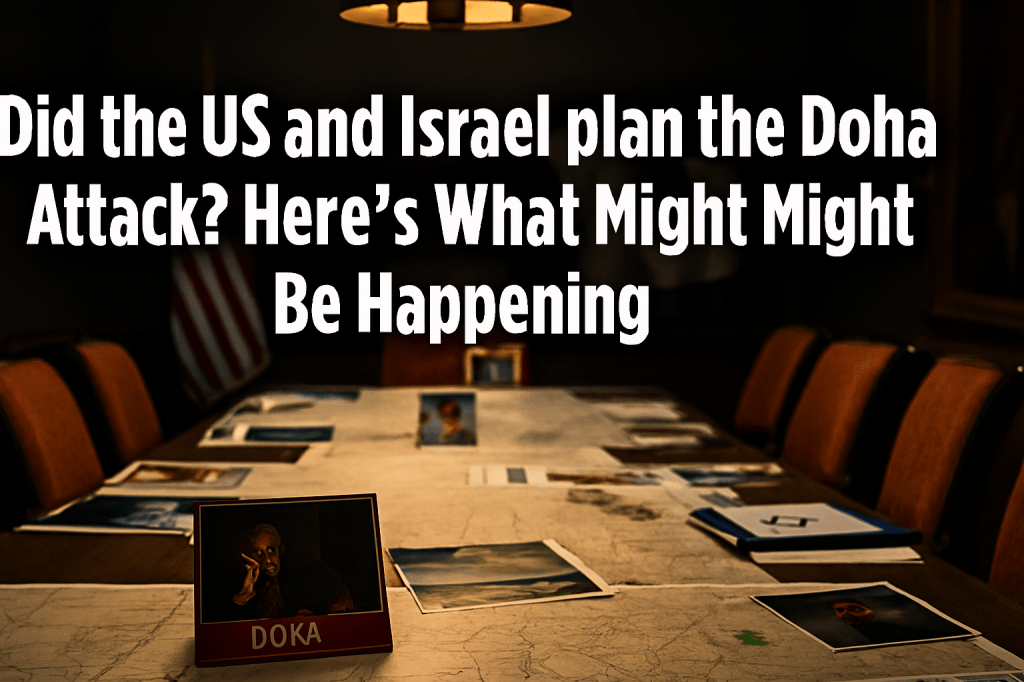
If you’ve been following the Middle East news lately, you might feel like you’ve stepped into a real-life political thriller. Yes, we’re talking about the Israel attack on Qatar, the mysterious 20-point Gaza plan by the U.S., and the unexpected twist of Pakistan backing off from the agreement. But here’s the kicker—what if everything you see now is just the opening scene of a 20-year-long game?
The Doha Strike: More Than Meets the Eye?
First things first, Israel attacked Doha, Qatar. Sounds shocking, right? But here’s the thing—no country is going to come on TV and say, “Yep, we planned it.” That would be like admitting to a heist on live TV while holding a mic. No one does that. Not the U.S., not Israel, not even a reality TV star.
This is why the “planned attack” theory isn’t something you can prove today. Everything is hidden behind diplomacy, secret meetings, and probably a few very stressed-out intelligence officers.
Pakistan’s Backflip
After the Doha strike and the U.S. releasing the 20-point Gaza plan, Pakistan initially seemed onboard. Then, plot twist: they said the document presented by the U.S. wasn’t the same as what they had discussed. Classic “Wait, this isn’t what I signed” moment.
It’s clear Pakistan is trying to distance itself, but this just adds fuel to the theory that the real game is happening behind closed doors.
The Chessboard
Here’s where it gets interesting. The theory goes like this:
- The attack on Qatar may have been a trigger or a calculated move to set the stage.
- The U.S. and Israel could be slowly taking control of Gaza through reconstruction, governance, and maybe even some “friendly” oversight.
- Gaza’s citizens or Hamas might have very limited say in this game.
- And Pakistan, along with other countries, might just be players reacting to the moves on the board, unsure whether to cooperate or back off.
Think of it like watching a chessboard where the pawns are moving slowly, and the real players are hiding behind the curtain sipping coffee.
How We’ll Know If This Theory Is Correct
Here’s the fun part: we don’t need a crystal ball, but we do need patience. The proof, if there is any, will come down the line, maybe in 2–3 years or even 10–20 years. Some signs to watch for:
- Gaza under partial or full control of Israel – if this happens, you know the moves were strategic.
- U.S. actively participating in reconstruction and infrastructure – military bases, buildings, and all that jazz.
- Militant groups neutralized or sidelined – this will show the plan is working exactly as imagined.
Right now, all we have are clues, signals, and patterns. Nothing is confirmed, but when the pieces start falling into place, the “game” will reveal itself.
Why This Theory Makes Sense
In geopolitics, nothing happens randomly. Powerful countries rarely announce their strategies. They move in shadows, manipulate crises, and wait for the perfect moment. And this theory fits perfectly with that playbook:
- Timing matters (Doha strike → U.S. pledge → 20-point plan).
- Regional actors are hedging or reacting (hello, Pakistan!).
- Ambiguity allows for maximum control later (Gaza governance, reconstruction).
Final Thoughts
So, yes, this is a theory. But it’s a very plausible theory, and the unfolding events could either prove it right or completely disprove it. For now, it’s a waiting game—like watching a suspense thriller and trying to guess the ending before the director says, “Cut!”
One thing is certain: the next few years in the Middle East are going to be anything but boring.
🌍 Stay Updated
For more market updates and SME stock insights, follow us on:
👉 YouTube – @stock3727
👉WordPress – https://stockresult.in/posts-page/
Enjoyed this post? Like, Comment & Follow my blog for more insightful content!

 Indian Stock Results